Bribing vs. Rewarding: What Paying for Performance Actually Does to Your Athlete's Brain
There is a difference between motivating your child and bribing them. One builds drive. The other quietly dismantles it.
By Dr. Yelena Gidenko | Neurocoach | Brain Health & Performance
I am sitting at day three of a championship swim meet right now. The air smells like chlorine and sunscreen. The noise is constant. And in between races, I keep hearing the same kinds of conversations in the stands.
"If you make the finals cut, we will stop for whatever you want on the way home."
"If you drop time today, I will give you something special."
"You need to swim faster. What is it going to take?"
The parents who say these things love their kids. They are not trying to create pressure. They are trying to find the lever that will get their child to dig deeper and perform at the level they know is possible.
But here is what most of them do not realize: that lever is slowly dismantling the very thing they are trying to build.
First, Let's Define What We Are Actually Talking About
A bribe is offered before the event. It is a conditional contract. You are promising something external in exchange for a specific outcome. The message, whether you mean it or not, is: "Your value today equals your result."
A reward is given after the event. It is an acknowledgment. You are celebrating effort, attitude, or growth, regardless of what the scoreboard says. The message is: "I see your work and your character, no matter what happened today."
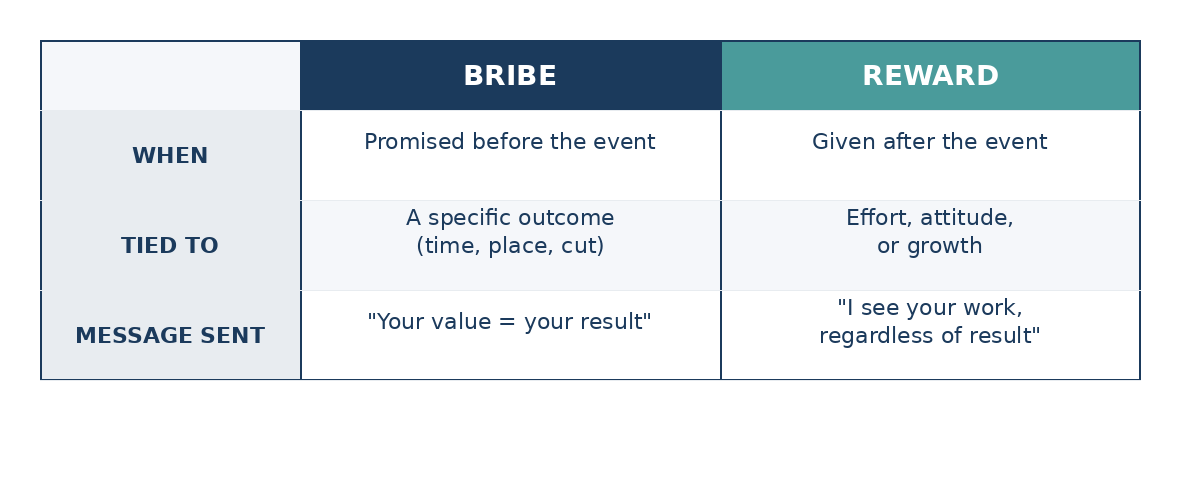
They look similar on the surface. But they function completely differently in your child's brain.
What Happens in the Brain When You Make Sport a Transaction
Human motivation is driven in large part by dopamine, a brain chemical that fuels the desire to pursue goals, push through discomfort, and feel satisfied when we accomplish something hard. Dopamine is not just a "feel good" chemical. It is a learning chemical. The brain uses it to decide what is worth pursuing.
When a child starts a sport, they are usually intrinsically motivated. They compete because it is fun, because getting better feels good, and because they want to see what they can do. Their brain releases dopamine from the activity itself.
But when parents start attaching conditional promises to specific outcomes, something important shifts. A well-documented phenomenon called the overjustification effect kicks in. In the foundational research on this topic, children who were promised a reward for doing an activity they already enjoyed showed significantly less interest in that activity afterward compared to children who received no reward. When the brain is trained to expect an external reward for something it already finds meaningful, it starts to treat the external reward as the reason for doing the activity. The internal satisfaction gets overwritten. The sport stops being the point. The prize becomes the point.
Over time, the child no longer swims because they want to. They swim because they are waiting for the payoff. And when the reward stops being exciting, or when it stops being offered, their motivation drops. You have not built drive. You have replaced it.
It is worth being clear here: not all external rewards are harmful. Unexpected celebrations, like taking your family out after a hard weekend of competition, do not carry the same risk. The problem is specifically the expected, conditional contract: "If you do X, you get Y." A 2025 narrative review of 97 studies found that intrinsic motivation rooted in enjoyment, personal goals, and self-determination is more likely to support sustained performance, while extrinsic motivation tends to produce shorter-term gains. The short-term gains from bribing are real. The long-term cost is also real.
The Pressure Problem
There is a second consequence that is just as important: conditional rewards increase performance anxiety.
When you tie a prize to a specific outcome, you shift the race from a challenge to a threat. The child's brain is no longer asking, "How can I compete at my best?" It is asking, "What happens if I fail to earn this?" That is a fundamentally different mental state.
Under challenge, the brain is focused, flexible, and able to access fine motor control and timing. Under threat, the body shifts into survival mode. Muscles tighten. Breathing becomes shallow. Mechanics break down. The athlete may still perform out of sheer adrenaline, but they are not developing the calm, focused mental game that produces consistent results over time. They are learning to perform under artificial pressure, which is a very different skill.
This matters even more for adolescent athletes, whose brains are already navigating identity, peer evaluation, and heightened sensitivity to social judgment. When a parent adds a conditional layer on top of that, the pressure compounds quickly.
What Your Athlete's Brain Actually Needs
Research on youth sport motivation consistently points to three core needs that, when met, produce athletes who are resilient, persistent, and genuinely driven.
They need to feel that the sport is theirs -- that they have ownership over their goals and choices, not that they are performing for someone else's reward.
They need to feel capable and improving -- that effort leads to growth, and that their progress is being noticed.
They need to feel valued as a person, not just as a performer -- that your love and presence are not conditional on the scoreboard.
Bribing undermines all three. It says: "You are doing this for my reward, not your own reasons. Your worth is measured by your result. And my approval depends on your performance."
Building these three needs looks different. It is slower. It is less dramatic. But it is what actually works.
Praise the process, not the outcome. Your child already knows if they won or lost. They do not need you to validate the scoreboard. They need you to validate the work. "I noticed how you kept your stroke together in that last fifty" lands differently than "Great race." It tells them you were watching the right things.
Ask questions instead of giving evaluations. "How did that feel?" "What were you focused on before the start?" "What is one thing you want to adjust next time?" These questions engage the thinking brain, build self-awareness, and train athletes to evaluate their own performance rather than waiting for external judgment.
Let the sport be their thing. Your job is to provide the opportunity, the support, and to show up. Their job is to decide how hard they want to work. You cannot buy intrinsic motivation. You can only create the conditions for it to grow.
Celebrate effort after the fact, not performance in advance. Spontaneous celebrations are healthy. Telling your child you are proud of how they handled a tough race, then going out for dinner because you love spending time together after a hard weekend, is not a bribe. It is connection. The key difference is that it was not promised as a condition of performance.
Say This, Not That
Here are a few direct swaps for the most common bribe-adjacent moments:
Instead of: "If you drop time today, we will stop for whatever you want."
Try: "Whatever happens today, I want to see you race your race. After, tell me one thing that felt good and one thing you want to work on."
Instead of: "You need to swim faster. What is it going to take?"
Try: "What is one thing you want to focus on in this race that has nothing to do with the clock?"
Instead of: "Great job winning."
Try: "I noticed how hard you pushed in that last lap. That looked like the work you have been putting in."
These scripts apply in any sport. The words shift slightly, but the principle is the same: keep the focus on effort, ownership, and growth.
A Quick Check Before You Offer a Reward
If you are not sure whether something crosses the line, ask yourself three questions:
Is this tied to an outcome or to effort and attitude?
Am I promising this ahead of time, or is it a spontaneous celebration?
Am I trying to control their performance, or support their ownership?
If the answer is outcome, promised ahead of time, and control, it is a bribe. If the answer is effort, spontaneous, and support, it is a healthy reward.
What If My Child Will Not Push Without Incentives?
This is the most common pushback, and it is a fair one.
If your child is coasting, the answer is not to remove all motivation. It is to shift where the motivation comes from. External rewards can jump-start behavior in the short term. The goal is to use that window to build internal reasons before the external ones wear out.
Start by getting curious. Ask your child what they actually like about their sport. What kind of athlete do they want to be? What would it feel like to race at their best? Then set process goals together, things that have nothing to do with the clock, like strong finishes, calm breathing before starts, or consistent effort in practice. Track effort and focus, not just times.
This takes longer. But it builds something that lasts.
The Long Game
The goal of youth sports is not just fast times or winning records. It is to help your child develop a brain that is resilient, focused, and capable of pursuing hard things long after they leave the pool or the field.
You cannot buy that. But you can build it, one honest, process-focused conversation at a time.
Shifting from bribes to building real motivation is not always easy. It is slower than promising rewards, and it requires a different kind of attention from you as a parent. If you want to understand how to support your athlete's drive without relying on conditional promises, and you're not sure where to start, let's talk. I work with parents to rebuild motivation from the inside out.
Want to know how your natural parenting style is shaping your athlete's mental game? Take the free What Type of Sports Parent Are You? quiz. In about five minutes, you will see your default motivational style and get two or three tailored strategies to support your child's drive without adding unnecessary pressure.


