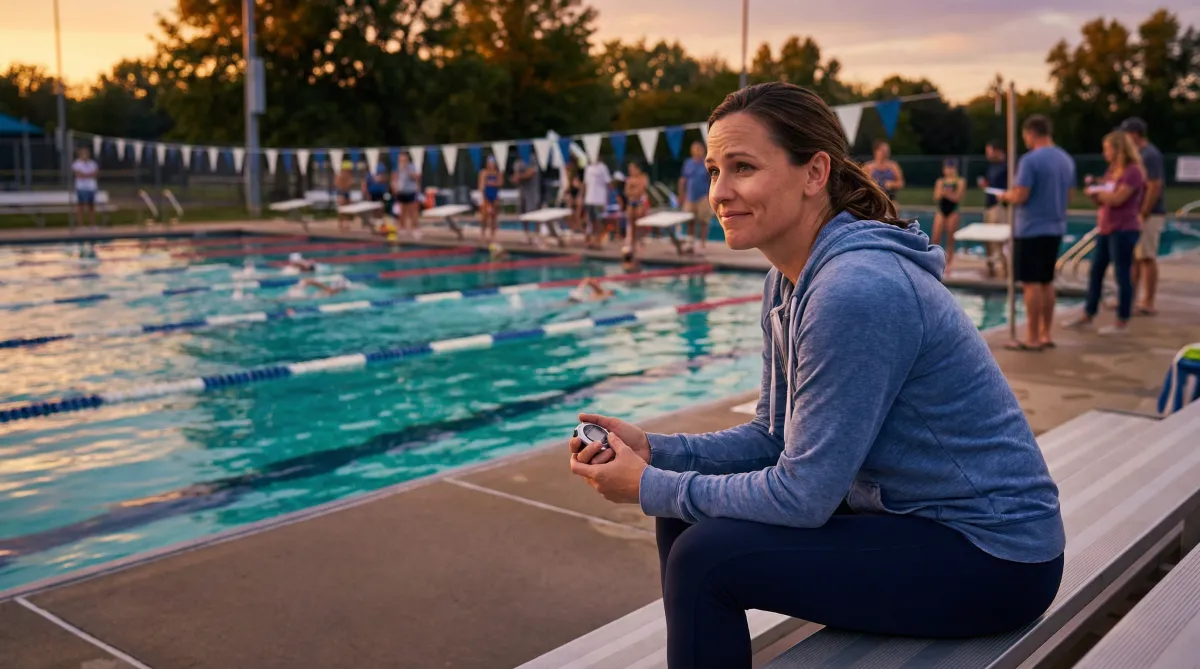
You're Not a 'Crazy Swim Parent.' You're a Human. Here's How to Stay Sane.
I had a conversation recently with a swim parent who asked one of the most honest questions I've heard in a while. She wanted to know how to stop herself from becoming what she called a "crazy swim parent." Her daughter is only nine, yet she finds herself constantly checking times, thinking about more lessons, and mentally replaying what her daughter could do better. She knows this kind of pressure can lead to burnout and take the joy out of the sport, but knowing that does not make the feeling go away. And when her daughter swims well and that wave of pride hits, it becomes even harder to quiet the urge to push for more.
If you relate to this, you are not a bad parent. You are a normal parent whose brain is doing exactly what it's designed to do.
That feeling of pride when your child succeeds? That's a powerful hit of dopamine, one of the brain's primary reward chemicals. It feels good. So good, in fact, that your brain starts to crave it. That craving is what drives you to check times, look for more lessons, and analyze their performance. Your brain is essentially saying, "That felt great! How can we get more of that?"
This isn't a character flaw. It's a biological loop. The problem is, that loop can quickly become a prison for both you and your child. You know this intellectually. You can see the cliff of pressure and burnout up ahead. But telling your brain to "just stop" is like telling your heart to stop beating. It doesn't work.
So, what does work? You have to outsmart your brain. You have to give it a different job to do. Here are five practical, no-nonsense strategies to reclaim your sanity and give your child the space to love their sport.
1. The 24-Hour Rule: Let the Dopamine Settle
This is non-negotiable. For 24 hours after a competition, game, or meet, there is to be zero analysis of the performance. None. No talking about what went right, what went wrong, what the coach said, or what their times were.
Why? Because right after a performance, everyone's brain (yours and your child's) is flooded with chemicals. Dopamine, adrenaline, cortisol… it's a mess in there. Trying to have a rational conversation in that state is impossible. It's like trying to do your taxes at a rock concert.
The 24-hour buffer allows the emotional tide to go out. It gives everyone's nervous system a chance to return to baseline. After 24 hours, if your child wants to talk about it, they will. But you are not allowed to initiate.
2. Fire Yourself as Coach. Write a New Job Description.
You are not the coach. You are not the agent. You are not the performance analyst. You have to consciously and deliberately fire yourself from these roles. They are not your job.
So, what is your job? It's time to write a new job description. Yours might look something like this:
Chief Encourager: Responsible for unconditional love and support, regardless of performance.
Director of Transportation: Manages all vehicle-related logistics to and from practices and games.
Head of Nutrition and Hydration: Ensures the athlete is fueled and hydrated. In other words, you're in charge of snacks.
Lead Memory Maker: Focuses on the fun, the friendships, and the life lessons outside the scoreboard.
Write it down. Post it on your fridge. When you feel the urge to start analyzing split times, go read your job description. It will remind you where your true value lies.
3. Change the Post-Game Conversation (Immediately)
The car ride home is the most dangerous place in youth sports. It's where good intentions go to die. You have to replace your performance-based questions with character-based ones.
Instead of asking, "How do you feel about your times?" or "Why did you miss that shot?" ask these questions instead:
"What was the most fun part of today?"
"Did you learn anything new from your coach or a teammate?"
"How did you handle that moment when things got tough?"
"What was it like encouraging your teammates?"
These questions shift the entire focus from performance (which is temporary) to character (which is permanent). You're signaling to your child that what you value most is not their stats, but their effort, their resilience, and their heart.
And for the love of all that is good, make the first thing you say to them when you see them be these six words: "I love watching you swim." That's it. No additions. No exceptions. That phrase communicates everything they need to hear from you in that moment.
4. Find Your Own Dopamine Source
Part of the reason you're so invested in your child's success is that it's your primary source of pride and excitement. You need to find your own game to play. You need a hobby, a project, or a pursuit that is just for you -- something that challenges you, allows you to fail, and gives you your own sense of accomplishment.
Whether it's learning to play guitar, joining a master's swim team, starting a garden, or finally writing that book, you need a place to channel your own competitive energy and ambition. When you have your own source of dopamine, you become far less dependent on your child's performance to feel good about yourself.
5. Anchor Their Worth (and Yours) in Something Unshakeable
This is the most important step. The parent I spoke with said she feels so proud when her daughter does well. That pride is the root of the problem. Not because pride is bad, but because it's attached to a fluctuating, external thing: performance.
As a Christian, you have access to an identity that is not dependent on performance. Your worth, and your child's worth, was sealed at the cross. It is finished. It does not go up when they win or down when they lose. It is the one constant in a world of variables.
Your job is to model this. It's to show your child that your love for them is a reflection of God's unconditional love -- a love that isn't earned by a faster time or a higher score. When they succeed, you can celebrate their hard work paying off. When they fail, you can remind them that this single event does not define them.
This is not easy. It's a daily, sometimes hourly, battle against your own brain and the culture of youth sports. But by implementing these practical steps, you can begin to untangle your identity from your child's performance and become the safe, steady, and sane parent they need you to be.
Ready to build a better strategy?
If you recognize yourself in this post and want to learn more practical, neuroscience-backed tools to help your child thrive without the pressure, let's talk. This is what I help parents do every day. Book a free, no-pressure discovery call, and let's figure out how you can become the most powerful force for good in your young athlete's life.


