
The Sweet Spot of Stress: How to Help Your Teen Athlete Perform Without Pushing Them Into Overdrive
Your teen does not need you to remove every hard feeling. They need you to stop adding pressure their brain cannot use.
By Dr. Yelena Gidenko, PhD | Neurocoach | Brain Health & Performance
A bad race. A missed shot. A strikeout. A quiet car ride home.
That is often the moment a well-meaning sports parent starts trying to help.
You replay the mistake. You point out what the coach may say. You ask why your athlete did not push harder. You remind them how much time, money, and effort has gone into this sport.
You may not be yelling. You may not think you are pressuring them at all.
But your athlete’s brain may hear something very different:
I disappointed you. I have to earn my place again. I cannot mess this up next time.
The goal is not to remove all stress from sport. It is to help your athlete carry the kind of pressure that sharpens focus, without adding the kind that pushes them into overdrive.
They need enough activation to engage, focus, and compete. They do not need so much that their brain shifts from performing the task to monitoring threat.
That is the sweet spot.
This is for parents of teen athletes in competitive sports, especially when practices, travel, money, future hopes, and high expectations have made every performance feel unusually important.
As a sports parent, your job is not to make competition easy. Competition is hard. Your job is to become a steady presence who helps your athlete stay connected to what they can control when pressure rises.
Key Takeaways
Pressure is not proof that you care. Your athlete needs support that protects ownership, not support that makes performance feel like a verdict on their worth.
A little activation can sharpen attention. Too much social pressure can pull attention away from the race, game, or routine and toward fear of disappointing other people.
Your athlete’s interpretation matters. A comment meant as coaching can land as criticism when they are already overloaded.
The best post-performance conversation is usually smaller than parents think. Start with one question that gives your athlete a choice.
Your steadiness is part of their support environment. You cannot control the result, but you can stop becoming another source of pressure.
Not All Stress Is the Problem
Let’s slow this down for a second.
Parents often hear “reduce pressure” and assume it means lowering standards, avoiding hard conversations, or pretending results do not matter.
That is not what this means.
Teen athletes need challenge. They need to learn how to compete when they are tired, disappointed, nervous, behind, or not having their best day. They need to learn that a mistake is information, not an identity.
The problem is not activation. The problem is overload.
A common way to explain the relationship between activation and performance is the inverted-U model. Too little activation can leave an athlete disengaged. Too much can interfere with attention and execution.
It is a simplified teaching tool, not a formula for every athlete. The amount and type of activation that helps can vary with the person, the task, their skill level, and the situation.
Before you say anything, ask yourself:
Is this pressure helping my athlete focus on the next task, or is it making them focus on what other people will think if they fail?
That is a much better question than, “Am I being hard enough?”
When a teen starts competing to avoid your disappointment, justify the cost of the sport, or protect their identity as “the talented one,” the competition becomes heavier than the task in front of them.
A swimmer stops thinking about the next stroke and starts thinking about the clock. A softball player stops reading the pitch and starts thinking about the last strikeout. A gymnast stops trusting a practiced routine and starts wondering whether the mistake will start another car-ride lecture.
At that point, they are not simply competing. They are managing your reaction while trying to compete.
They do not need both.
What Your Athlete’s Brain May Be Doing Under Pressure
Your athlete does not need a parent who becomes a neuroscientist in the bleachers. You do need to understand one simple pattern.
When a teen interprets a competition, or a parent’s reaction, as threatening, the body can shift into a protective stress response. Heart rate may rise. Muscles may tighten. Attention may narrow. Thoughts may speed up.
That response is not a character flaw. It is not always under conscious control in the moment either.
Your athlete may not be able to simply switch the feeling off on command, even though regulation skills can be learned over time.
The problem is not that activation exists. The problem is when it becomes so intense that it makes it harder to access timing, flexible attention, and trust in practiced skills.
This is why “Just relax” rarely works.
The athlete is not trying to be difficult. Their brain is responding to the meaning it has attached to the moment.
And parents are part of that meaning.
A systematic review of youth-sport research found that autonomy-supportive parenting, moderate involvement, positive parent-child relationships, and a focus on learning were linked with healthier motivation in young athletes.
That does not mean parents need to be passive. It means the manner and level of involvement matter.
In a 2025 study of 219 competitive athletes ages 13 to 19, athletes who perceived more frequent parental pressure and directive behavior also reported more burnout and more controlled motivation. That does not mean one parent comment creates burnout. It does mean athletes’ experience of their parents’ words, tone, and behavior matters.
Another study of young soccer players found that the athletes reported more parent pressure and active involvement than they wanted, and less praise and understanding than they wanted.
Read that again.
What parents experience as involvement may not be what their athlete experiences as support.
That is not an accusation. It is a correction.
You can love your child deeply, sacrifice for their sport, and still unintentionally make performance feel like a test they have to pass to keep peace at home.
Good parents do this when they are anxious too. They want to protect their athlete from regret. They want the work to pay off. They want to make sure their child does not waste an opportunity.
But once your anxiety starts directing the conversation, your athlete begins carrying two competitions: the one in front of them and the one they feel at home.
Their effort should not have to include managing the emotional weather around them.
The Difference Between Support and Pressure
Support says, “I am with you. You are responsible for your effort and your next decision.”
Pressure says, “Your performance is affecting me, and you need to fix it.”
The words may sound similar on the surface. The message underneath them is not.
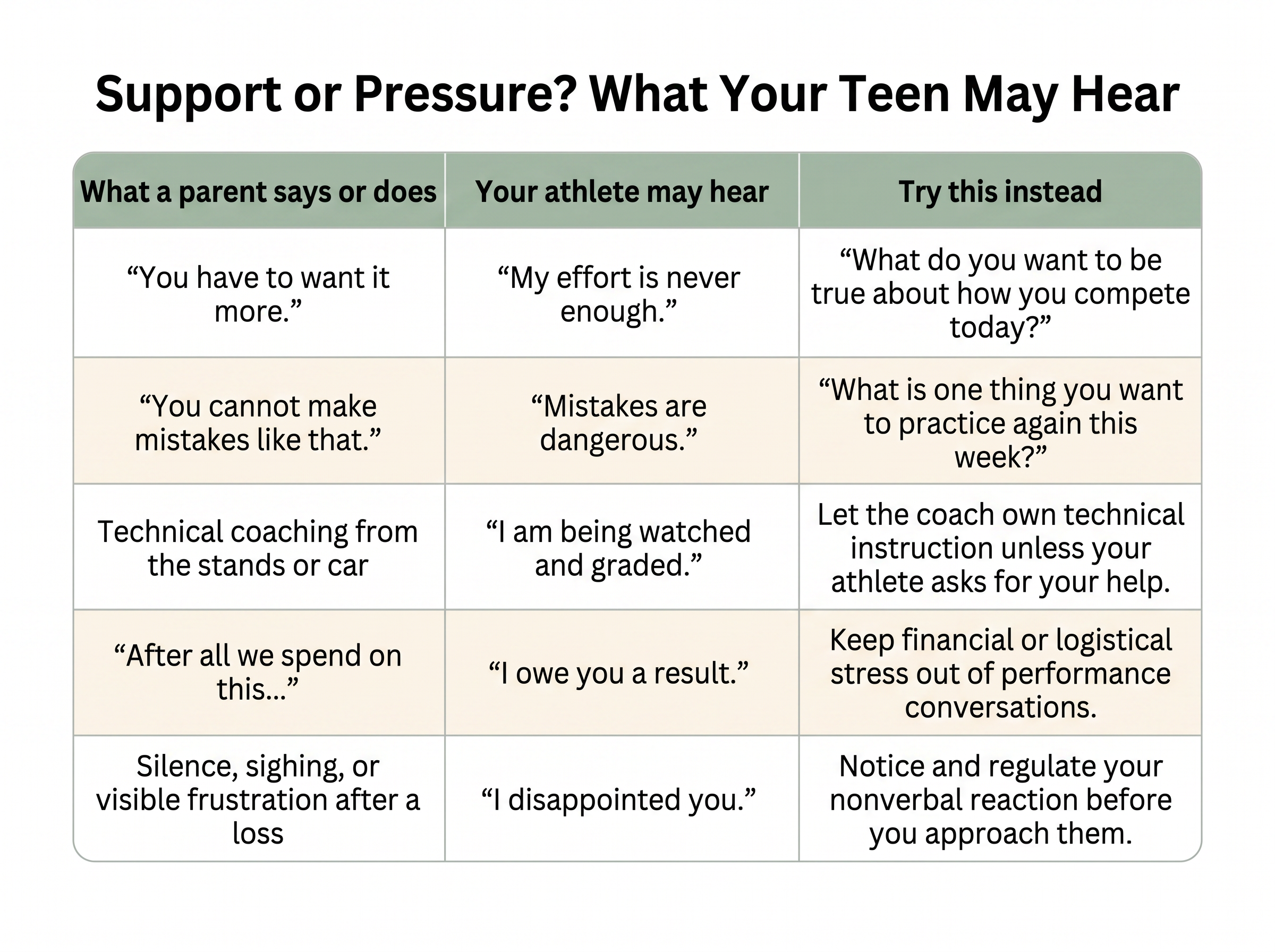
This is not about becoming detached. It is about becoming useful.
Parents sometimes overcorrect by moving from over-involvement to saying nothing. That is not the answer either. Your athlete still needs you. They need rides, meals, boundaries, encouragement, consistency, and a safe place to land after hard performances.
They also need ownership.
Research with adolescent tennis players found that higher perceived parental expectations were associated with greater competitive anxiety. The athletes’ sense of competence was part of that pattern.
That makes sense in real life.
When your athlete believes, “I should already be better than this,” every mistake becomes evidence that they are failing. When they believe, “I can learn, adjust, and keep going,” a mistake still matters, but it does not become a crisis.
Your job is to help them stay in the second pattern.
The Sweet Spot Is Not a Mood. It Is a Message.
A lot of sports-parent advice focuses on emotion: stay calm, be positive, do not get too invested.
That is not wrong, but it is incomplete.
You are going to care. You may get nervous. You may feel disappointed when you watch your child struggle. You are a parent, not a robot.
The goal is not to feel nothing. The goal is to stop handing your unprocessed emotion to your athlete.
Your athlete does not need you to manufacture confidence for them. They need you to communicate that they are still loved, still safe with you, and still responsible for their own response when things do not go their way.
That creates room for healthy activation.
A parent who is steady before competition can communicate one clear message: This matters, but it does not define you.
A parent who becomes reactive after competition can communicate something different: This result has now become a family emergency.
Those messages shape the environment your athlete competes in.
Faith has something to say here too. Parents are called to prepare, guide, and show up. We are not called to control every outcome. You can prepare the horse for battle without trying to become the one who controls the victory.
That is not passive parenting. It is disciplined parenting.
You prepare the ride, the food, the schedule, the equipment, and the home environment. You teach character. You hold boundaries. You help your athlete learn from mistakes.
Then you release the result that was never yours to control.
One Tool for the Next Three Competitions: The Post-Performance Pause
You do not need a long new routine. You need one clean change.
Before the next competition, tell your athlete:
“I love watching you compete. What matters most to me is that you stay with your plan and learn from the day.”
Then, when the performance is over, do not lead with analysis. Do not ask what happened. Do not begin teaching in the car.
Start with this question:
“Do you want listening, encouragement, or help thinking through one thing?”
Then do what they choose.
If they say listening, listen. Do not correct the story while they are still processing it.
If they say encouragement, keep it specific and grounded. “I saw you stay with it after that hard first half” is more useful than “You did great” when they know they did not perform the way they wanted.
If they say help thinking through one thing, ask one question. “What do you think you want to work on next?” Let them name it before you offer your view.
This tool works because it gives your athlete something pressure takes away: a sense of agency.
You are not abandoning them. You are communicating, “I am here, and I trust you to have a voice in what you need next.”
That is different from letting them avoid responsibility. If your athlete needs to address poor effort, disrespect, missed commitments, or a pattern of quitting, you can still have that conversation.
Just do not confuse a post-performance nervous system with a teachable moment.
Unless there is a safety, conduct, or logistical issue, do not introduce performance analysis immediately. Wait until your athlete asks for it or you have both had time to settle.
If you are also a qualified coach, that does not automatically make immediate technical feedback helpful. Keep technical feedback with you only when your athlete has explicitly asked for it and you have agreed beforehand when and how that feedback will happen.
Not every conversation has to happen in the first ten minutes after a race, game, or meet.
At some point, you have to stop trying to think your way out of the whole situation. Make it smaller. Ask what your athlete needs now. Save the larger conversation for a calmer moment when their brain can actually receive it.
What to Watch for in Yourself
Parents often ask, “How do I know if I am putting too much pressure on my athlete?”
Start with your own patterns.
Do you feel your body tighten before they compete?
Do you replay their mistakes longer than they do?
Do you feel embarrassed, angry, or personally rejected when they underperform?
Do you need them to do well before you can relax?
Do you keep giving technical advice they did not ask for?
These questions are not here to shame you. They are here to help you recognize what is actually happening.
Your athlete may be carrying pressure from training, coaches, teammates, school, social media, and their own expectations. They do not need to carry yours too.
If you notice your emotional state rises and falls with their performance, that is your next piece of work. It is not your child’s job to steady you through their sport.
You can care deeply and become steadier at the same time.
That is the kind of parent an athlete remembers.
Frequently Asked Questions
Should I stop giving my athlete feedback completely?
No. Stop giving uninvited feedback when your athlete is emotionally flooded or when the coach already owns the technical role. Ask first. If your athlete wants your perspective, keep it to one observation or one question. Do not turn every performance into a review meeting.
What if my teen says they want me to push them?
Clarify what “push” means. They may want accountability, a reminder of their goal, or help following through on practice commitments. That is different from criticism or emotional pressure. Ask what specific support helps them compete better and what crosses the line.
How do I help an athlete who shuts down after a bad performance?
Give them time before you ask for a lesson. A simple “I am here when you want to talk” is enough at first. Later, use the Post-Performance Pause and let them choose listening, encouragement, or help with one next step.
Does pressure ever help athletes perform better?
Challenge can help when your athlete experiences it as meaningful, manageable, and connected to their own goal. Pressure is more likely to become harmful when an athlete experiences it as a threat to belonging, worth, emotional safety, or their ability to recover from mistakes.
When should we seek more support for our athlete or family?
Seek qualified support when distress is persistent or intense, when sport enjoyment disappears, when your teen withdraws from normal life, or when there are major changes in mood, sleep, eating, school functioning, or safety. Coaching can teach skills, but it does not replace clinical or medical care.
Try This at the Next Competition
Before: “I love watching you compete. Stay with your plan and learn from the day.”
After: “Do you want listening, encouragement, or help thinking through one thing?”
Avoid: Technical analysis, disappointment cues, and questions that demand an immediate explanation.
Your Athlete Needs You Steady
Here is what I want you to hear.
You do not have to become less invested in your teen’s sport. You have to become less reactive to it.
Your athlete is going to have bad days. They are going to lose, miss, freeze, underperform, and make choices you would not make. That is part of learning how to compete and part of learning how to become an adult.
Your response can make the moment heavier or help them return to the next task.
So before the next competition, decide what kind of pressure you want to remove from the room.
Then use one question after the performance:
“Do you want listening, encouragement, or help thinking through one thing?”
That question will not solve everything. It will do something more useful. It will show your athlete that home is not another place where they have to perform.
If you are unsure whether your involvement feels supportive or pressuring from your athlete’s perspective, the free two-minute Sports Parent Quiz can help you identify one pattern to work on first.
Your steadiness can be one of the most important parts of your athlete’s support environment.


