
What Is Actually in Your Athlete’s Sports Drink? A Practical Look at Food Dyes, Focus, and Fuel
By Dr. Yelena Gidenko | Neurocoach | Brain Health & Performance
If you have spent time at a meet, tournament, or practice lately, you have seen the bottles lined up by the benches. Bright colors. Big claims. Words like fuel, electrolytes, energy, and performance.
Most sports drinks are not mysterious. They are usually water, carbohydrate in the form of sugar, electrolytes such as sodium and potassium, flavoring, and sometimes food coloring. The question is not whether every sports drink is “good” or “bad.” The question is whether it makes sense for your athlete, in that setting, on that day.
For most routine youth practices and shorter events, water is the right starting point. Sports drinks may have a place during prolonged, vigorous activity, extended tournaments, or hot conditions with heavy sweating. Energy drinks are a different category entirely and do not belong in a young athlete’s game-day plan.
Let’s slow this down for a second. You do not need to turn the concession stand into a nutrition lab. You need to know what you are buying, what your athlete actually needs, and what is adding noise without adding value.
Key Takeaways
Start with the sport, not the bottle. Duration, intensity, heat, access to water, and individual sweat loss matter more than marketing.
Sports drinks and energy drinks are not the same thing. Check for caffeine and stimulant ingredients first.
Food dyes do not fuel performance. Current evidence raises concerns about behavior in some children, but does not prove that dyes cause focus problems in every athlete.
Sugar is not automatically the problem. It can provide usable carbohydrate during demanding exercise, but a sports drink is not necessary for every practice or car ride home.
Use one simple checklist before game day. The goal is prepared, steady fuel, not a perfect drink.
What Is Actually in the Bottle?
Parents usually look at the front label first. That is understandable. The front is designed to make a fast decision feel easy.
“Hydration.”
“Zero sugar.”
“Performance.”
“Electrolyte support.”
Then the bottle goes into the cart without anyone checking what is actually inside it.
Turn it over instead.
Most sports drinks contain some combination of water, carbohydrate, sodium, potassium, acids, flavoring, and color. That is not automatically a problem. Water supports hydration. Sodium can help replace sodium lost in sweat. Carbohydrate can be useful when an athlete is exercising hard for a long period or has repeated events with limited recovery time.
But none of those ingredients tell you whether the drink is needed.
A one-hour volleyball practice in an air-conditioned gym is not the same situation as a soccer tournament with several games in high heat. A swimmer with multiple long events is not the same as a teen doing a short strength session after school. An athlete who has had regular meals and access to water is not in the same place as one who has skipped lunch, rushed from school, and has hours of hard training ahead.
That is why the bottle cannot make the decision for you.
The American Academy of Pediatrics’ background guidance makes an important distinction: sports drinks are designed to provide fluid and, in some settings, carbohydrate and electrolytes. Energy drinks are designed around stimulants such as caffeine and should not be treated as a sports drink.
This is the first place parents get tripped up.
A drink marketed as energy is not necessarily providing the hydration and fueling plan an athlete needs. It may instead, or also, contain caffeine and other stimulant ingredients.
The First Question: Is This a Sports Drink or an Energy Drink?
Do not assume the word sport on the shelf means the product is appropriate for a teen athlete.
Read the ingredient list and the nutrition label. Look first for caffeine, guarana, yerba mate, pre-workout blends, or other stimulant ingredients. Taurine is also common in energy drinks, even though it is not itself a stimulant. These belong in a separate category from a standard sports drink.
The Centers for Disease Control and Prevention notes that energy drinks can contain high levels of caffeine and other stimulants. For children and adolescents, those ingredients can interfere with sleep and contribute to symptoms such as nervousness, irritability, or a racing heart. Energy-drink guidance is clear that these drinks are not a hydration strategy for young athletes.
That matters because sleep is part of performance.
A teen does not need a caffeinated drink at 5:00 p.m. that makes it harder to settle at 10:30 p.m. before an early game the next day. That is not a performance plan. It is borrowing alertness from tomorrow.
So make this your first game-day rule:
| If the drink has caffeine or stimulant ingredients, it is not your athlete’s hydration plan.
You do not need to argue about every product. You need one clear boundary.
Food Dyes: What They Do and What They Do Not Do
Food dyes are where the conversation often gets louder than the evidence.
A sports drink can be neon blue, red, or orange and still be marketed as performance fuel. The color may make the product look more exciting, but color does not hydrate an athlete. It does not provide carbohydrate. It does not replace electrolytes. It does not improve focus.
That is the simple part.
The more careful part is this: concerns about artificial food colors are real, but the claim needs to stay accurate. The American Academy of Pediatrics’ current parent guidance explains that research has linked artificial food colors with increased hyperactivity or behavior changes in some children. It does not say every child will react the same way, and it does not prove that a dyed sports drink will cause a focus problem in every athlete. Healthy Children’s review of food dyes is a good place to start.
That gives parents a balanced answer.
You do not need to panic over one brightly colored drink at a tournament. You also do not need to pretend that the color is doing anything helpful.
If you suspect a particular product is not agreeing with your athlete, notice the pattern over time rather than drawing a conclusion from one practice or one tournament. Consider the full context, including caffeine, timing, food intake, sleep, training load, and the specific ingredients.
The goal is not to label a drink as toxic. The goal is to remove what is unnecessary when your athlete needs clarity, steady energy, and a body that can recover.
A practical step is to look for the dye names and numbers on the ingredient list. Common examples include Red 40, Yellow 5, Yellow 6, Blue 1, and Blue 2. You may also see “artificial colors” or “certified colors.”
That does not mean a dye-free product is automatically a better sports choice. A dye-free drink can still contain a lot of sugar or ingredients your athlete does not need. It simply means you are reading the whole label instead of letting the color make the decision.
Sugar Is Not Automatically the Villain
This is where parents often swing too far in the other direction.
A drink with sugar is not automatically bad. During prolonged, intense exercise, carbohydrate can be useful because it gives the body a quickly available fuel source. That is part of why standard sports drinks contain sugar.
But a standard sports drink on the way to school, during a short practice, or sitting in the car after every activity is not the same thing as strategic fueling.
The problem is not simply sugar. The problem is using a performance product when there is no performance need.
A bottle can become the default because it is convenient. It is cold. The team is drinking it. The label sounds athletic. Soon, a teen believes they cannot practice without it.
That is not the message you want to build.
Your athlete’s body needs regular meals, enough fluids, consistent sleep, and the right kind of recovery. No sports drink can replace those basics.
A balanced pre-event meal or snack often does more for steady energy than a last-minute sugar drink. A water bottle that is actually accessible often matters more than buying the perfect flavor. And a young athlete who arrives at practice already underfed or dehydrated needs a bigger look at their routine, not a quick-fix bottle.
You cannot predict an individual athlete’s focus, endurance, or performance from an ingredient list. What you can do is make a clearer decision about whether the drink fits the demands of the day.
The Label Check: Four Things to Look For
At some point, you have to stop trying to decode every marketing claim. Make it smaller.
Use this four-part label check.
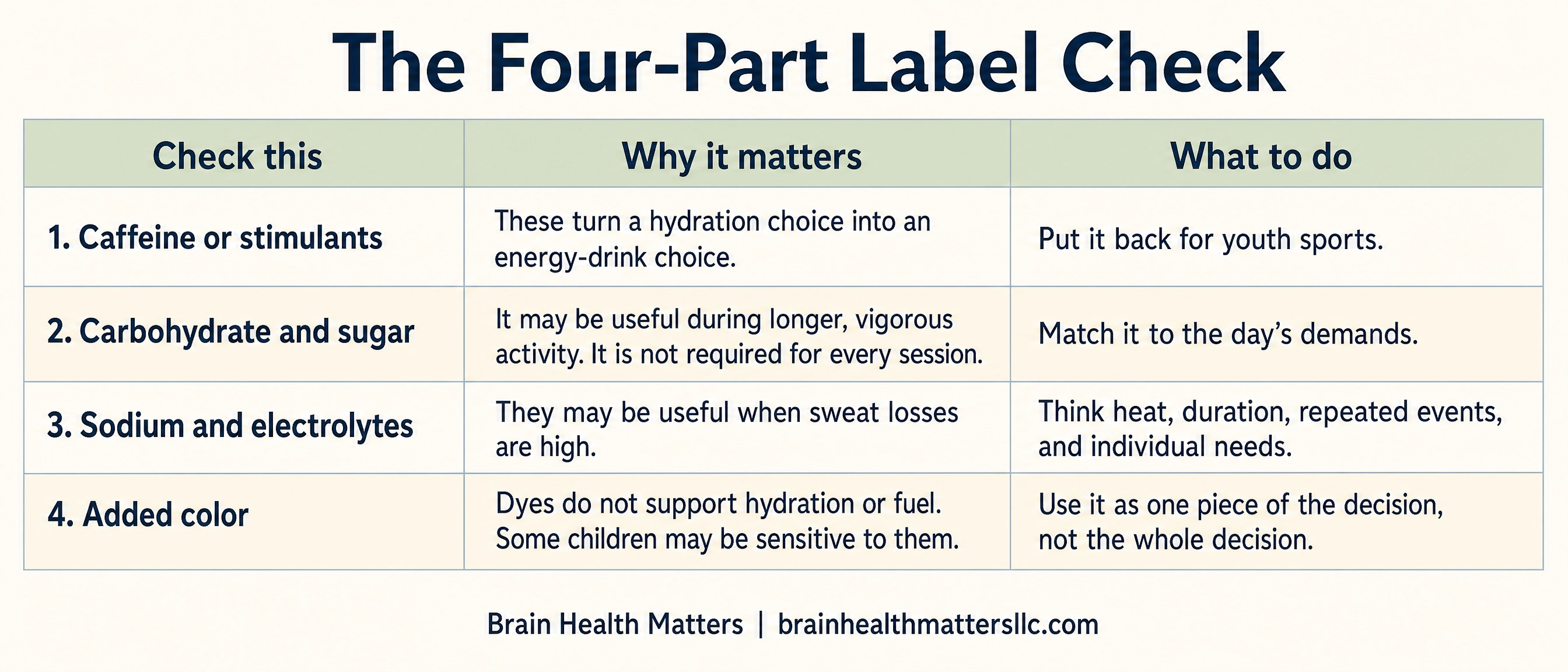
This is not about getting every choice perfect. It is about becoming more intentional.
The same parent who reads the label on a sports drink can also ask a better question in the car:
| “What kind of day does your body have ahead of it?”
That turns fuel into a conversation about awareness rather than restriction.
A Practical Tool: The Game-Day Fuel Checklist
You do not need a complicated sports-nutrition plan to use this. Use it before the next game, practice, meet, or tournament.
Before You Pack the Bag
Start with the event.
How long will your athlete actually be active? Will they have multiple events? Is the weather hot or humid? Is there regular water access? Have they had a meal and a snack that day? Does the coach or athletic trainer have specific hydration guidance for the team?
Those questions matter more than brand names.
In the Hours Before the Event
Choose familiar food that includes carbohydrate, protein, and fluids. Adjust the timing and portion to your athlete’s schedule and what they tolerate well. This is not the day to introduce a new supplement, a caffeinated drink, or a food your athlete has never tolerated well.
Pack water first.
If activity is prolonged or unusually demanding, especially with repeated events, heat, humidity, or substantial sweating, consider whether a sports drink or electrolyte option fits the plan you have already chosen. Do not wait until the event has started to decide what your athlete will have available.
During Activity
Make water easy to reach. For most routine practices lasting about an hour or less, water is generally the practical starting point, unless a qualified clinician or athletic professional has advised otherwise.
For longer, hotter, higher-sweat, repeated-event, or medically complex conditions, follow guidance from the team’s athletic trainer, your pediatric clinician, or a sports dietitian. Those needs can differ based on the athlete, sport, temperature, medical history, and sweat loss.
Do not use energy drinks as a shortcut for fatigue.
And do not let the color of the drink become the point. The goal is hydration and usable fuel, not a bottle that looks more athletic than it is.
After the Event
Return to the basics.
Offer water. Plan a normal snack or meal with carbohydrate and protein. Give your athlete time to eat, cool down, and settle before turning the ride home into a performance review.
Notice what happens over time. Does your athlete arrive at the second half of an event focused and steady? Do they complain of stomach discomfort with a certain drink? Do they consistently skip food and then rely on a bottle to catch up?
Patterns are more useful than one isolated game.
What Parents Often Miss
Sports-drink decisions are rarely just about sports drinks.
They are often about a rushed morning, a skipped lunch, a late practice, a car full of gear, and a parent trying to keep everyone moving. The bottle becomes the fastest thing to grab.
That makes sense. But it is worth looking at what the bottle is replacing.
Is it replacing a snack your athlete did not have time to eat?
Is it replacing water they forgot to pack?
Is it replacing sleep after a late night?
Is it replacing a conversation about how hard their schedule has become?
A teen athlete does not need perfection around food. They need a routine that is simple enough to repeat.
That is what supports their brain and body over time: consistent basics, not a frantic search for the product that promises the most.
Frequently Asked Questions
Are sports drinks bad for teen athletes?
No. A sports drink can be useful during prolonged, vigorous exercise, repeated events, or high-heat conditions. It is not necessary for every practice or everyday hydration. Start with the actual demands of the event and water access, then decide whether added carbohydrate and electrolytes make sense.
Is an energy drink the same as a sports drink?
No. Energy drinks are built around stimulants such as caffeine. Sports drinks are intended to provide fluid and may include carbohydrate and electrolytes. Parents should read labels rather than rely on the name or color of the product. Caffeinated energy drinks are not a youth hydration strategy.
Do food dyes affect focus in every athlete?
No. Food dyes do not improve focus, but current pediatric guidance does not support a universal claim that they cause problems in every child. Some children may show behavior changes or sensitivity. If you suspect a particular product is not agreeing with your athlete, notice the pattern over time and consider the full context, including caffeine, timing, food intake, sleep, training load, and the specific ingredients. Discuss ongoing concerns with the appropriate clinician.
What should my athlete drink during a long tournament?
That depends on the sport, weather, duration, sweat loss, medical history, food intake, and recovery time between events. For extended or hot conditions, use a plan supported by the team athletic trainer, pediatric clinician, or sports dietitian.
Is a dye-free sports drink always the better choice?
Not automatically. Dye-free products may remove an unnecessary additive, but you still need to check for sugar, sodium, caffeine, and other ingredients. Look at the whole label and the demands of the event rather than using one claim as a shortcut.
Your Next Step
You do not need to buy a new drink for every practice. You need a clearer way to decide.
Start with the Game-Day Fuel Checklist before the next event. Pack water first. Read the label. Separate sports drinks from energy drinks. Match the drink to the actual demand of the day.
Download the free Game-Day Fuel Checklist: a one-page guide to help you choose water, a sports drink, or a food-based option based on your athlete’s actual day.


