
Welcome to the Brain & Faith Blog
This is where neuroscience and Scripture meet to bring clarity, calm, and confidence into everyday life. From brain health tips and faith-based practices to practical support for parents of young athletes, you’ll find simple, actionable steps to strengthen your mind, nurture your spirit, and guide your family toward lasting peace and resilience.
What Elite Athletes Know About Performing Under Pressure That Applies Directly to Your Life
It is not about confidence. It is about nervous system regulation.
By Dr. Yelena Gidenko | Neurocoach, Brain Health & Performance
When we watch elite athletes perform under immense pressure, we tend to assume their secret is confidence. We think they just believe in themselves more than the rest of us. They have a mental switch they can flip. They are wired differently.
That is not wrong, but it is incomplete.
A core skill underneath elite performance is not confidence. It is nervous system regulation. The ability to stay functional while nervous. To perform while uncomfortable. To recover quickly after a setback. To stay present under pressure even when everything in your body is signaling threat.
And here is what I want you to notice: moms need those exact same skills every single day.
Key Takeaways
Elite athletes feel nervous. They are trained to regulate their physical response to that nervousness.
Nervous system regulation is a trainable skill, not a fixed trait.
Heart rate variability (HRV) is one useful marker of autonomic flexibility and how well your nervous system recovers from stress.
Performing while uncomfortable is a skill that transfers directly from athletics to parenting and daily life.
You do not need to feel calm to take the next step. You need to regulate enough to function.
What Nervous System Regulation Actually Means
Your nervous system has two primary modes. The sympathetic mode activates when you perceive a threat. Heart rate increases. Breathing becomes shallow. Muscles tense. Attention narrows. The body is preparing to respond.
The parasympathetic mode activates when you feel safe. Heart rate slows. Breathing deepens. Muscles relax. Thinking becomes clearer. You can access your full cognitive capacity.
Most people experience these as involuntary states. Something stressful happens, and the sympathetic system fires. They feel overwhelmed, reactive, or shut down, and they wait for it to pass.
Elite athletes are trained differently. They learn to intentionally shift their nervous system from high activation back toward regulation. Not to eliminate the stress response, but to manage it. To stay functional within it.
Research on autonomic nervous system control in elite athletes shows that they are highly skilled at managing their physiological responses. They do not eliminate stress. They manage it with precision.
Heart Rate Variability: The Measure of Regulation
One of the most useful concepts in understanding nervous system regulation is heart rate variability, or HRV. This is the variation in time between consecutive heartbeats. It sounds technical, but the concept is straightforward.
HRV is commonly used in sports science to track recovery, training adaptation, and autonomic balance. A higher HRV generally reflects a more flexible nervous system, one that can ramp up when needed and recover more efficiently when the demand passes. A lower HRV can indicate the system is under sustained load and recovering more slowly.
Research shows that athletes with higher HRV perform better under pressure. They recover more quickly after setbacks. They can access their best thinking even when their body is under stress.
This is trainable, though people differ in their starting point. And it is built through consistent practice of regulation techniques, not through willpower or positive thinking.
Where Moms Need This Skill
Let us be honest about what a typical week looks like for a swim mom.
Early morning practices. Work. Dinner. Homework. Managing a teenager's emotional state after a disappointing practice. Navigating college recruiting conversations. Handling an injury. Dealing with a coach conflict. Managing your own career, your marriage, your health.
Every one of those situations can trigger a sympathetic response. Every one of them requires you to function while activated.
How often do you wait for the anxiety to pass before you respond to your teenager? How often do you snap because your system is already overloaded and one more thing tips it? How often do you lie awake at night because your nervous system never fully downregulated from the day?
I have watched clients struggle with this exact thing. They are capable, competent women who are simply running on a chronically activated nervous system. They are not weak. They are untrained in regulation.
Their athletes are getting explicit training in how to manage their physiological state. The moms are not.
Performing While Uncomfortable
Here is the shift that matters most.
Most people believe they need to feel calm before they can function well. They wait for the anxiety to go away. They wait until they feel ready. They wait for confidence to arrive before they take action.
Elite athletes cannot afford to wait. They have to compete right now, nervous system and all. So they learn to perform while uncomfortable. They learn to take action while activated. They learn that the feeling of nervousness does not mean they are not ready. It means their body is preparing.
This transfers directly to your life.
You do not need to feel perfectly calm to have a hard conversation with your teenager. You do not need to feel confident to make a difficult decision. You do not need to feel at peace to take the next step.
You need to regulate enough to function. That is all. Not perfect calm. Just enough regulation to access your best thinking and take the next right action.
You do not need the full plan. You need the next step. Regulate your system enough to take it.
How to Train Your Nervous System
This is not complicated. But it does require consistency.
Breathe with intention. The single most accessible regulation tool is your breath. Specifically, extending your exhale longer than your inhale activates the parasympathetic system. Try breathing in for four counts and out for six as a starting point. The exact ratio that works best varies by person, but the principle is consistent: a longer exhale than inhale tends to support parasympathetic activity. Do this for two minutes when you feel your system activating. It is not a magic fix. It is a direct physiological signal.
Use your body to change your state. Your nervous system responds to physical input. A slow walk. Cold water on your face. Unclenching your jaw and dropping your shoulders. These are not small things. They are direct inputs to your nervous system that signal safety.
Practice regulation before you need it. Do not wait until you are in crisis to start calming your system. Build short regulation practices into your day. Three slow breaths before you get out of the car at school pickup. A brief pause before you respond to a stressful text. These micro-practices train your nervous system to default to regulation rather than reactivity.
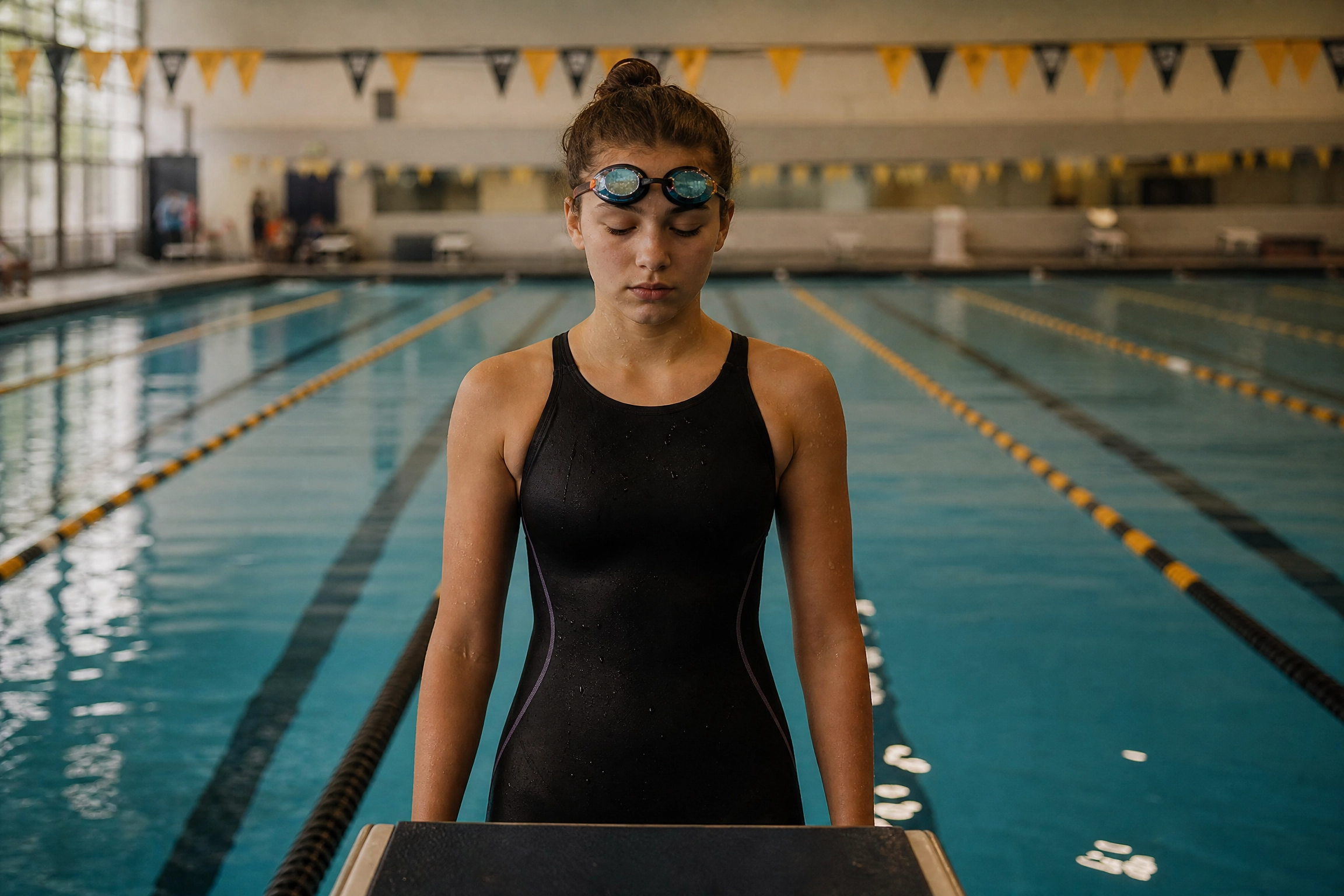
Act while uncomfortable. This is the hardest one. The next time you feel activated and you know what the right next step is, take it anyway. Do not wait for the feeling to pass. Take the step while nervous. This is exactly what your swimmer does behind the block. It is exactly what you can do in your daily life.
The Bigger Picture
Confidence is not the goal. Regulation is.
When your nervous system is regulated, clearer thinking tends to follow. You can access your values. You can respond rather than react. You can stay present with your teenager instead of escalating. You can make decisions from a grounded place instead of a reactive one.
This is not about becoming a different person. It is about training the person you already are to function better under pressure.
Your swimmer is getting that training. It is time for you to get it too.
Frequently Asked Questions
Why does my brain keep overthinking?
Your brain is trying to solve a physiological problem (an activated nervous system) with a cognitive solution (thinking). It does not work. You have to regulate the body first, then engage the mind.
Why do I feel anxious even when I know the truth?
Because your body is reacting to stress. Your nervous system does not care what you know intellectually. It is responding to a perceived threat. You have to calm the body before the mind can fully process the truth.
How do I actually calm my mind in real time?
Regulate your breathing. Focus on your physical environment. Bring your attention back to the present moment. These are not soft suggestions. They are direct inputs to your nervous system.
How do faith and brain science work together?
God gave us physical bodies with nervous systems that respond to our environment. Learning to regulate that system is part of stewarding what He gave us. Peace that passes understanding is a real experience, and it is also a physiological state that can be cultivated.
Why do I feel stuck even when I am trying?
You are probably waiting to feel confident before you act. Action builds confidence, not the other way around. Regulate enough to function, then take the next step.
Elite athletes are not fearless. They are trained to reset their nervous system quickly.
You can learn to do the same thing.
If this is what you are dealing with, this is your next step: The next time you feel overwhelmed, take three slow, deep breaths before you do anything else. Not to fix everything. Just to regulate enough to take the next right step.

Brain Health Matters, LLC
Helping busy minds find peace through faith and neuroscience.


© 2025 Brain Health Matters, LLC. All rights reserved.
Terms & Conditions