
Welcome to the Brain & Faith Blog
This is where neuroscience and Scripture meet to bring clarity, calm, and confidence into everyday life. From brain health tips and faith-based practices to practical support for parents of young athletes, you’ll find simple, actionable steps to strengthen your mind, nurture your spirit, and guide your family toward lasting peace and resilience.
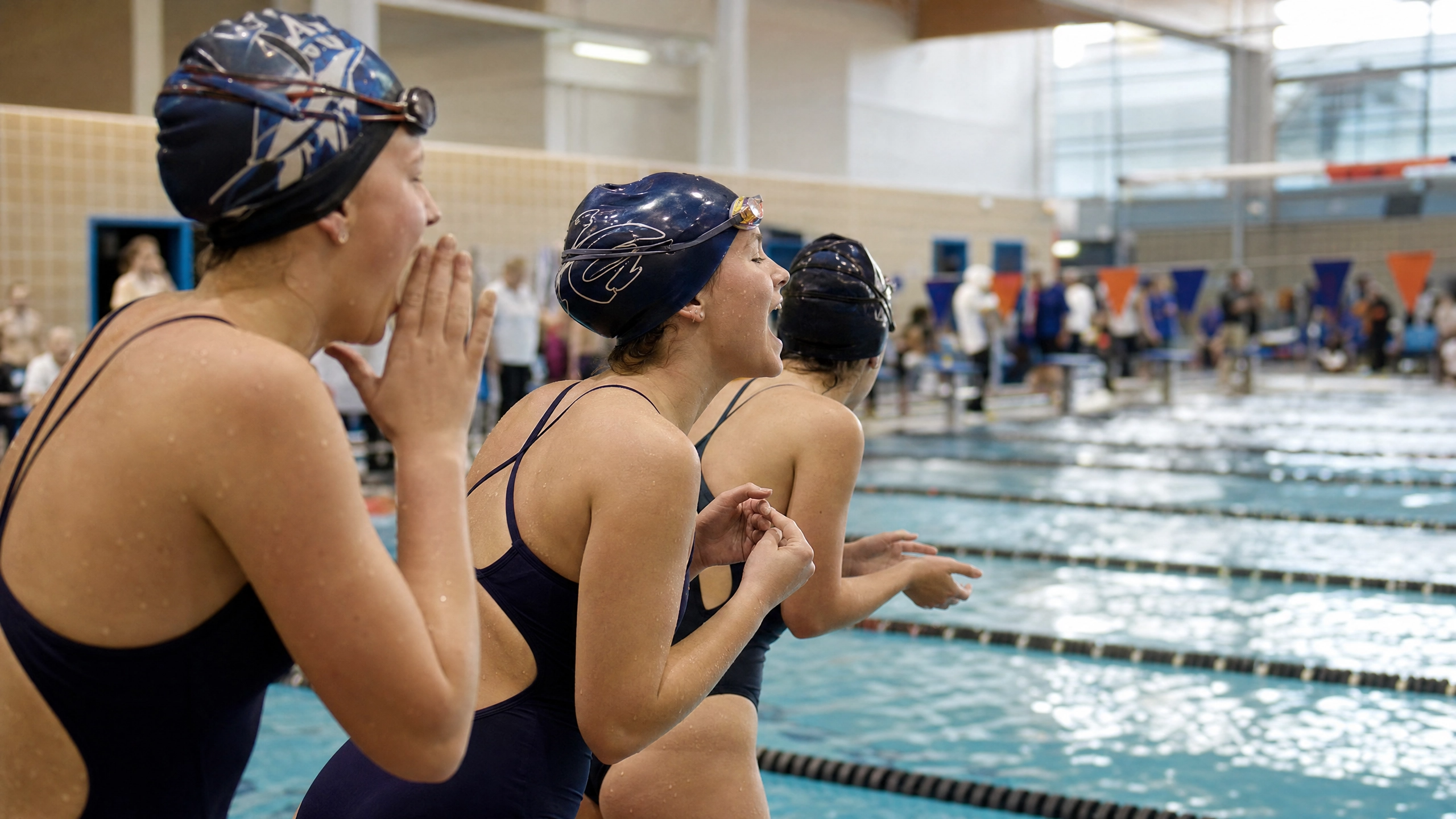
What Happens in Your Swimmer's Brain When Teammates Cheer
The neuroscience of why cheering for your teammates actually works.
By Dr. Yelena Gidenko | Neurocoach, Brain Health & Performance
I just spent three days at a swim meet -- prelims and finals -- and the contrast between teams was impossible to ignore.
On some teams, you could count on a group of swimmers at the end of the lane for almost every race. Screaming. Leaning over the water. Fully engaged regardless of the event or the heat.
On others, most swimmers were on their towels, looking at their phones, occasionally glancing up when someone they knew was on the block.
It got me thinking about what is actually happening at the edge of that pool. Not just culturally or emotionally, but neurologically.
When a swimmer is cheering for a teammate, it is easy to assume they are just being nice, following a coach's rule, or building "team spirit." But as a neurocoach, I see something more specific happening. I see a real, measurable neurobehavioral exchange.
Cheering is not just noise. It is an active social signal that can shape attention, motivation, confidence, and coordination in the swimmer in the water, the teammate doing the cheering, and the team's overall cohesion.
Here is the science behind why the loudest team at the end of the lane often has an advantage that goes far beyond physical conditioning.
The Impact on the Swimmer Racing: Social Facilitation
When your swimmer is in the middle of a race, their body is under significant physical stress. Lactic acid is building. Oxygen is depleting. The brain is receiving signals to slow down and protect the body from exhaustion.
Then, they turn their head to breathe and see three teammates leaning over the gutter, screaming their name.
What happens next is explained by a concept called social facilitation. Research shows that verbal encouragement during both sprint and endurance exercise is associated with significant increases in physical performance output. For well-practiced skills, like a competitive swimmer executing their stroke, that social support can help the athlete maintain effort and access reserves they might not tap into if they were racing in silence.
The mechanism is not a single chemical reaction. It is a shift in attention, arousal, and motivation. The swimmer's brain is receiving a signal that says: someone sees you, someone is invested in this moment, keep going. That signal has a measurable effect on how long and how hard they push.
When teammates show up at the end of the lane, they are contributing to the performance happening in the water. That is not a metaphor.
The Impact on the Swimmer Cheering: More Than Moral Support
Here is the part most people miss: the swimmer doing the cheering is not just doing something kind. They are doing something that benefits their own brain.
When a swimmer gets off their towel, walks to the edge of the pool, and invests their energy into supporting someone else, they are engaging in prosocial behavior. Research on prosocial behavior and the brain shows that acts of encouragement and support are associated with activation in the brain's reward circuitry. This is the neurological basis of what researchers call the "helper's high" -- a documented shift in mood and well-being that comes from supporting others.
Think about the swimmer who just added two seconds to their best time. The natural impulse is to sit alone, replay the race, and ruminate. But if they choose to walk to the lane line and cheer for the next heat, they are actively interrupting that stress loop. They are shifting their attention outward, engaging their reward system, and giving their nervous system something to do other than spiral.
Cheering is not a distraction from their own performance. It is a neurological reset.
There is also a more direct brain-to-brain element at work. A published study on cheering found that it enhanced inter-brain synchronization between the sensorimotor areas of the player and the observer. Observers who cheered reported a stronger sense of unity with the person they were supporting and showed greater sensorimotor activation than those who watched passively. Cheering is not a passive act. It is an interpersonal brain event.
The Impact on the Team: Cohesion and Shared Momentum
When you look at the teams that consistently perform well across a long meet, you rarely see isolated athletes. You see cohesion. And cohesion is not just a personality trait or a coaching style. It has a neurological and social foundation.
Positive social interactions between teammates -- including cheering, celebrating, and showing up for each other -- are associated with the kind of trust, cooperation, and collective motivation that research on team sports links to stronger group performance. When athletes feel genuinely supported by their teammates, they tend to be more motivated, more resilient after setbacks, and more willing to give full effort.
Emotions are also highly contagious within a group. The energy and intensity at the end of the lane does not stay there. It spreads through the team. The positive momentum generated by one race can elevate the readiness and confidence of the swimmers waiting for the next event. That is not guaranteed, and it does not work the same way for every team. But the pattern is consistent: teams that actively support each other tend to build shared momentum that individual effort alone cannot create.
Designed for Connection
None of this should surprise us. We were not designed to operate in isolation. We were built for community.
When the Apostle Paul wrote, "Carry each other's burdens," he was providing spiritual instruction. But as is often the case, the neuroscience closely parallels the theology. When we step out of our own self-focus and actively support someone else, we are operating in alignment with how we were designed. We lift them up, and in the process, our own nervous systems benefit.
This is not a coincidence. It is design.
Practical Steps for Swimmers, Coaches, and Parents
For the Swimmer: Make cheering a non-negotiable habit, especially after a bad race. When you feel the urge to isolate and replay what went wrong, recognize that your brain is trying to trap you in a stress loop. Break the loop by walking to the edge of the pool and pouring your energy into a teammate. You will swim your next event better because of it.
For the Coach: Do not just demand cheering as a team rule. Explain the science. Tell your athletes that standing at the end of the lane is a performance strategy, not just a character expectation. Make it part of the training culture so it is automatic at the big meets, not something you have to remind them to do.
For the Parent: Watch your swimmer's behavior on the deck. Are they engaged with their team, or are they isolated on their phone? Gently encourage them to be the loudest voice at the end of the lane. Their energy is not wasted on someone else's race. It is an investment in themselves.
I watched three days of racing this weekend. The swimmers who showed up at the end of the lane, event after event, were not just more fun to watch. They were more resilient. They bounced back faster after hard swims. The teams where more swimmers did this kept their energy up through the finals session in a way that isolated athletes simply did not.
That is not coincidence. That is what happens when a group of athletes figures out that cheering for each other is not separate from competing. It is part of it.

Brain Health Matters, LLC
Helping busy minds find peace through faith and neuroscience.


© 2025 Brain Health Matters, LLC. All rights reserved.
Terms & Conditions