
Brain Health Matters Blog
Practical neuroscience, brain health, performance, and faith for everyday life.
Explore simple tools for a calmer mind, healthier habits, stronger families, and greater resilience.

Morning and Evening Habits to Help an Overloaded Brain Settle
The goal is not a beautiful, rigid routine. The goal is to give your brain enough repeated cues that it does not have to guess what happens next.
By Dr. Yelena Gidenko | Neurocoach | Brain Health & Performance
Some mornings begin before you have fully arrived in your own body.
The alarm goes off. You reach for your phone. Messages, headlines, schedules, and other people’s needs are waiting before your feet hit the floor. By lunchtime, you have been productive, responsive, and mentally pulled in twelve directions. Then night comes, but your brain does not seem to get the memo.
You may be physically tired and mentally wide awake.
Many women assume the answer is more discipline. A stricter bedtime. A more impressive morning routine. A better planner. A supplement. A complete digital detox.
But here is what often helps first: simple, repeatable anchors at the beginning and end of the day.
Your brain and body run on rhythms. They use signals such as light, darkness, activity, meals, and sleep timing to organize a 24-hour pattern of alertness and rest. Light is one of the main signals the brain uses to regulate our circadian rhythm, helping the body know when to be alert and when to prepare for sleep.
That does not mean you need to control every hour. It means your overloaded brain may settle better when it gets a few clear, repeated signals about what time of day it is.
Key Takeaways
Your circadian rhythm is an internal timing system that helps coordinate daily patterns of alertness and sleep.
Morning light and evening light have different effects on circadian timing. Morning light tends to move the clock earlier, while evening and nighttime light tend to move it later.
Regularity matters. Sleep timing that changes widely from day to day can make it harder for the body to settle into a predictable rhythm.
A morning anchor and an evening anchor can be brief. The best ones are simple enough to repeat on ordinary days.
Ongoing sleep disruption, loud snoring, breathing pauses, severe daytime sleepiness, or persistent mood changes are reasons to speak with a qualified healthcare professional.
Your brain keeps time, even when your calendar does not
Circadian rhythms are roughly 24-hour patterns that help coordinate many processes in the body. The sleep-wake cycle is the one you notice most easily, but timing also shapes patterns of alertness, hormone activity, body temperature, and behavior.
The master clock is a small region of the brain called the suprachiasmatic nucleus, or SCN. It receives information about light from the eyes and helps coordinate timing throughout the body.
You do not need to memorize that name. You only need to understand the practical point: your brain pays attention to the signals you repeat.
Light exposure can affect your circadian rhythm differently depending on the time of day. Broadly, morning light shifts the circadian clock earlier, while evening and night light shift it later. That is one reason a bright screen late at night can work against the wind-down you want, especially if late-night scrolling keeps your brain stimulated long after you intended to rest.
The issue is not that phones are evil or that a busy woman needs one more rule. The issue is that your brain responds to the pattern you create most often.
If your first cue each morning is urgency and your last cue each night is more input, your brain may have fewer clear boundaries between “be on” and “begin powering down.”
An anchor is different from a routine
A routine can become long, fragile, and easy to quit. An anchor is smaller: one repeatable action that helps your brain recognize a transition.
A morning anchor might be opening the blinds, stepping outside briefly, and choosing the day’s top priority before email. An evening anchor might be lowering the lights, writing tomorrow’s three priorities, and putting your phone on its charger.
These are cues, not magic. Repeating them reduces decision-making for a tired brain.
The morning anchor: tell your brain the day has started
Start your morning with the most basic cue available: light.
Daytime light exposure can influence both sleep timing and sleep quality. Earlier light tends to move timing earlier, while later light can be associated with more nighttime disruption. Open the blinds, sit near a bright window, or step outside while you drink coffee. Outdoor light is generally much brighter than indoor lighting, even on cloudy days.
Then pair the light cue with one decision that protects your attention.
Try this three-part morning anchor:
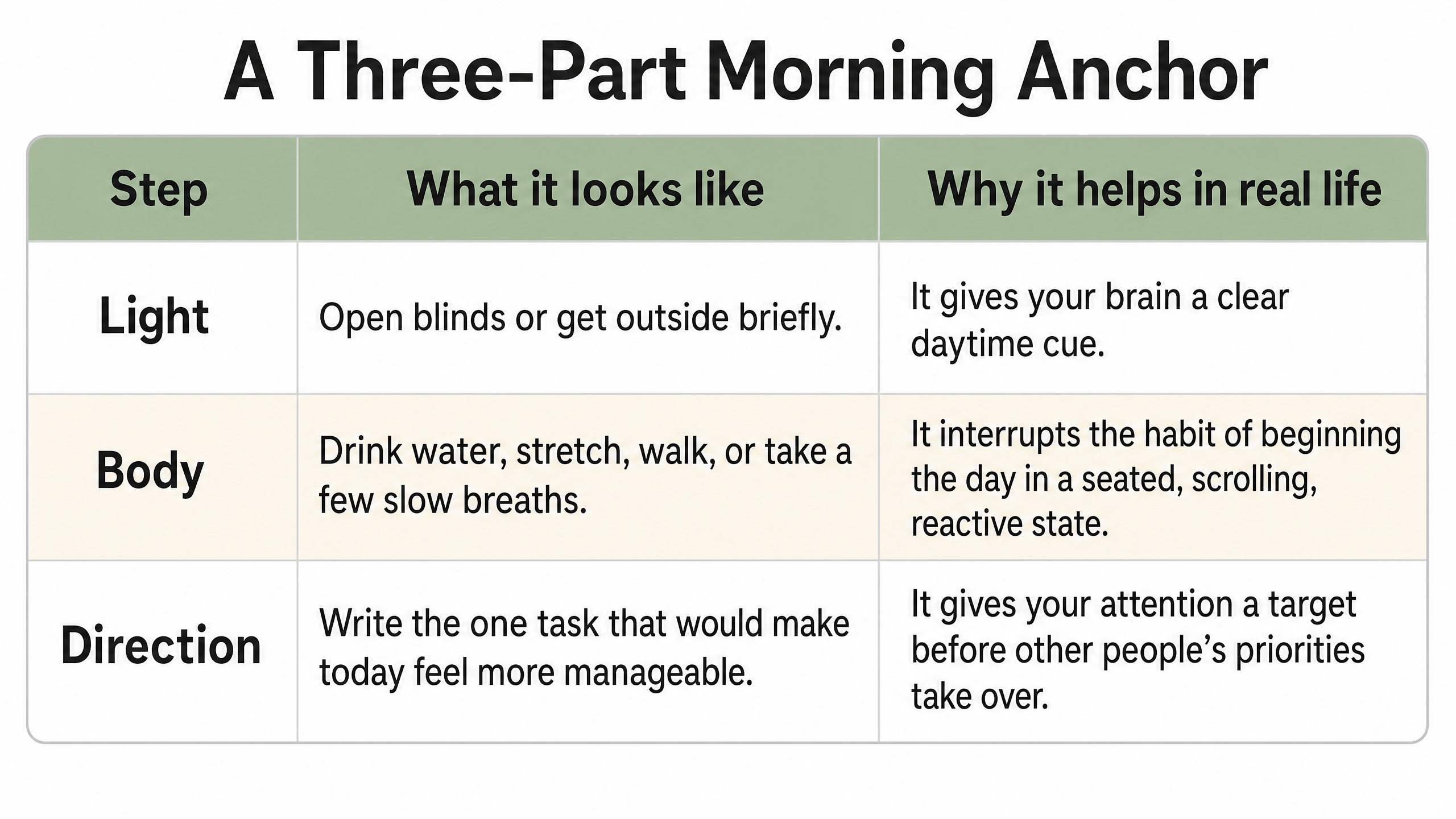
Notice what is not on the list: checking every message, making a perfect plan, or solving the whole day before 7:00 a.m.
Your job is to enter the day with a little more intention than urgency.
The evening anchor: stop asking your brain to stay on duty
The hardest part of evening is often the lack of a clear ending. One task becomes another, then you get in bed with a brain still carrying tomorrow.
Your brain needs a bridge between productivity and sleep. A peer-reviewed review describes sleep as shaped by both built-up sleep need and circadian timing. You cannot force sleep like a switch, but you can create a steadier runway into it.
Start with an evening boundary cue. Choose a time when you stop adding new tasks if you can. This does not mean the whole house has to be quiet or that every responsibility disappears. It means you stop treating the last hour of the day like a second workday.
Next, use a light cue. Dim the room, move bright screens farther away, and turn off autoplay. One difficult night does not ruin your sleep. The question is what your usual pattern is teaching your brain.
Then use a closure cue. Write down what is unfinished and tomorrow’s first three priorities. The list gives your tasks a place to go besides your head.
A simple evening anchor might look like this:
Dim lights and stop nonessential work.
Write down loose ends and tomorrow’s first three priorities.
Put the phone on its charger outside the bedroom or across the room.
Do one quiet repeatable activity: shower, stretch, read a few pages, pray, or sit with a cup of tea.
Get into bed without starting a new conversation with the internet.
The point is not to be rigid. The point is to create an ending your brain can recognize.
Why regularity matters more than a “perfect” bedtime
You may not go to bed at the same minute every night. Still, there is a difference between flexibility and chaos.
A 2022 study of women in later adulthood found that more irregular sleep timing was associated with poorer psychological health across several measures. Because it was observational, it cannot show cause and effect. It does support looking at sleep rhythm, not only total hours.
Think in ranges. Keep wake and wind-down times in a similar general window when possible. After a disruption, return to your anchors rather than deciding you have “blown it.”
A one-week anchor experiment
Do not overhaul your life this week. Choose one morning action and one evening action that fit your actual schedule.
Use this experiment for seven days:
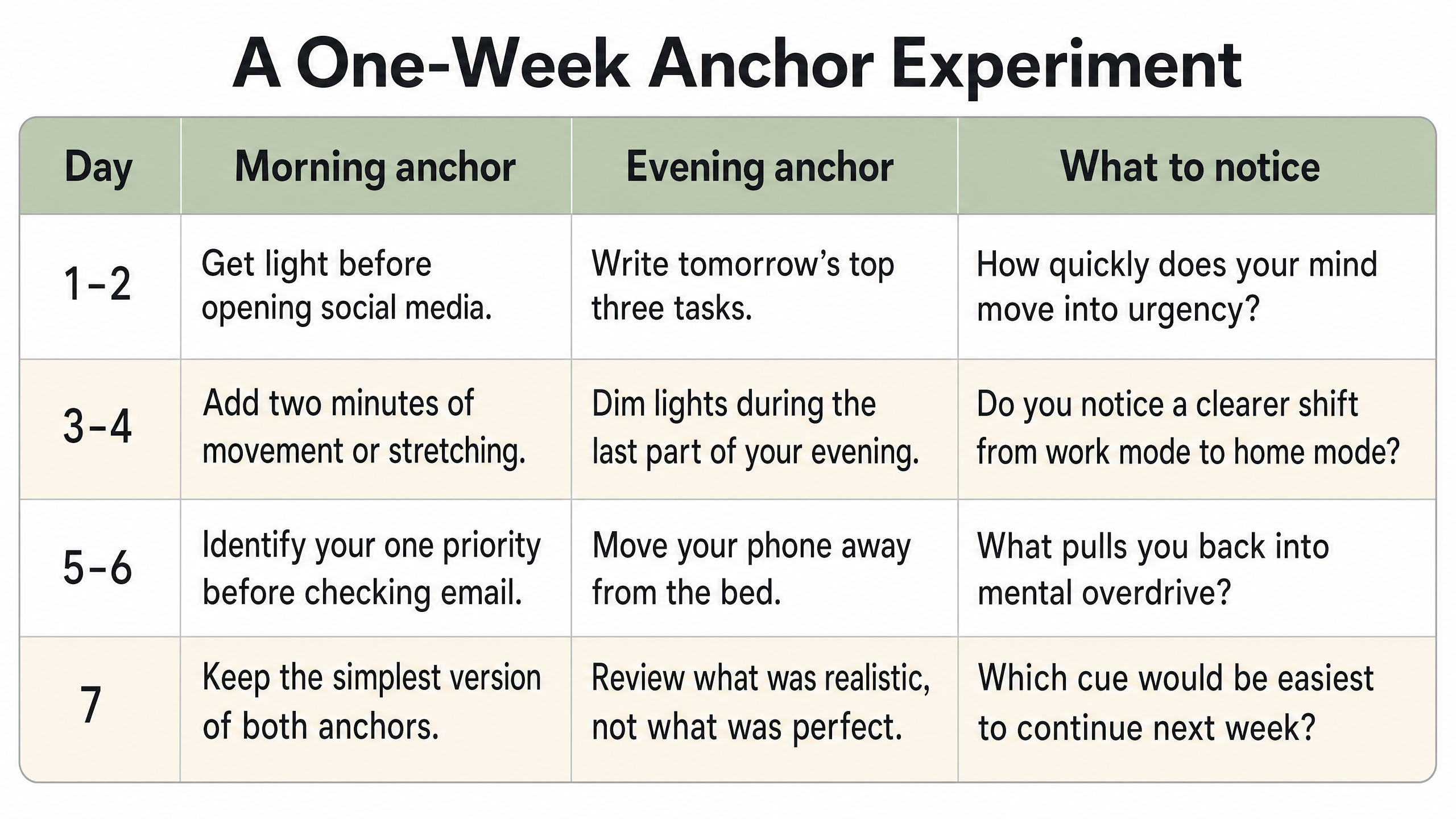
If faith is part of your daily rhythm, add a short prayer at one anchor point. In the morning, it may be: “God, guide my attention toward what matters today.” At night, it may be: “God, I release what I cannot carry into tomorrow.”
Prayer is not one more productivity habit. It is a way to remember that you are not the source of control for every person and outcome in your life.
What to do when your schedule is unpredictable
Shift work, newborn care, caregiving, travel, and athletic schedules can make consistent timing harder. Use sequence anchors when clock-time anchors are not possible. A sequence anchor happens after something stable in your day:
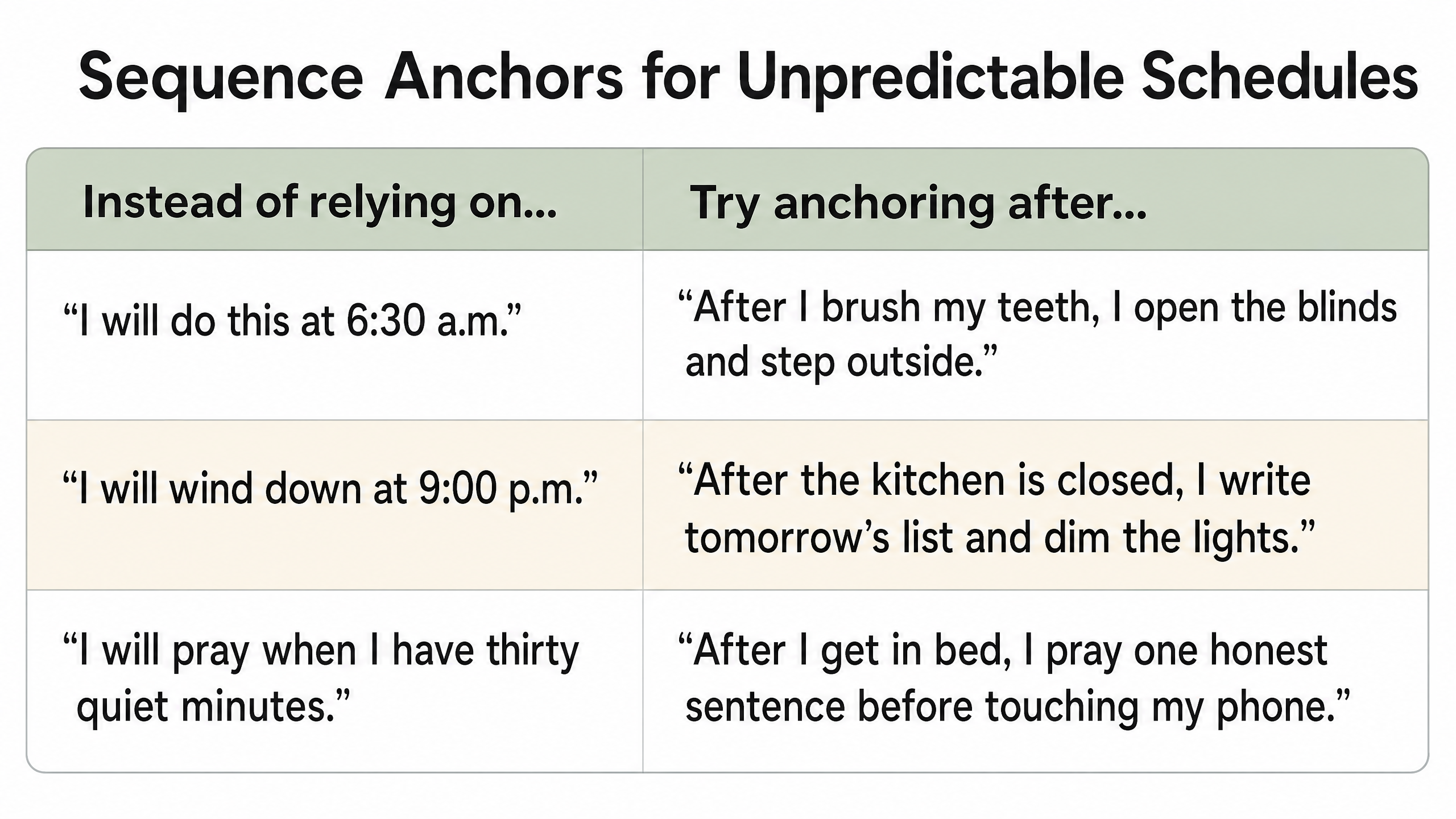
This gives you flexibility without leaving every part of your day to chance.
When sleep concerns deserve medical attention
Morning and evening anchors can support healthy habits. They cannot diagnose or treat a sleep disorder, depression, anxiety disorder, hormonal concern, medication effect, or medical condition.
Talk with an appropriately qualified healthcare professional if you have persistent insomnia, loud snoring, gasping or breathing pauses during sleep, severe daytime sleepiness, a sudden major change in sleep, or mood symptoms that are new, severe, or persistent.
This article provides education and practical brain-health habits. It is not medical advice, diagnosis, or treatment. New, severe, or persistent symptoms should be discussed with an appropriately qualified healthcare professional.
Give your brain fewer mixed messages
An overloaded brain does not need a Pinterest-worthy routine. It needs a few clear signals that say, “The day has begun,” and later, “You are allowed to stop carrying today.”
Pick one morning cue and one evening cue. Make them small enough that you can keep them on a hard day. Then repeat them for a week before deciding whether they work.
Knowing that rest matters is one thing. Changing the pattern when you are tired, overloaded, and used to putting everyone else first is another. If you have tried to reset your habits on your own and nothing has lasted, you do not need another list of things you should do. You need support that helps you build a different daily rhythm. I help women retrain the stress, sleep, and thought patterns that keep them stuck in overdrive.
For a simple place to begin, download 5 Habits That Quietly Steal Your Peace.
Small, repeated cues can help your brain remember that rest is part of a well-lived life.

Brain Health Matters, LLC
Brain health for real life under pressure.


© 2026 Brain Health Matters, LLC. All rights reserved.