
Brain Health Matters Blog
Practical neuroscience, brain health, performance, and faith for everyday life.
Explore simple tools for a calmer mind, healthier habits, stronger families, and greater resilience.

Why Does Stillness Feel So Hard When Your Brain Is in Overdrive?
You do not need to empty your mind. You need a small way to return to the present when your mind has been running ahead of you all day.
By Dr. Yelena Gidenko | Neurocoach | Brain Health & Performance
You finally sit down.
The house is quiet. The tasks are mostly done. You have the rare five minutes you said you needed all day.
And instead of peace, your mind gets louder.
You remember the email you did not answer. The appointment you need to schedule. The conversation you keep replaying. The child you are worried about. The work task that is already waiting for tomorrow. You may even open your phone again because scrolling feels easier than sitting still with the noise.
If that is you, stillness is not hard because you are lazy, undisciplined, or failing at mindfulness. It is hard because when the outside demands quiet down, your mind finally has room to show you what it has been holding.
The answer is not to force yourself into an hour of silence or try to make your thoughts disappear. A more useful starting point is a short practice that gives your attention somewhere steady to go. Mindful awareness involves noticing what is happening in the present without getting pulled into every thought or reacting to every feeling.
Stillness does not require a blank mind. It requires a gentler relationship with the mind you have.
Key Takeaways
An active mind during quiet moments is common. Your brain does not simply switch off when the room gets quiet.
Mindfulness is not about eliminating thoughts. It is about noticing thoughts without following every one of them.
Long practices are not the only option. A short, repeatable attention practice is a practical place to begin.
Prayer can be part of a return-to-the-present practice without turning faith into another task to complete.
If worry, sadness, panic, or sleep disruption is severe or persistent, it deserves qualified professional support.
Why quiet can make the noise feel louder
Many women carry their days in motion.
You move from work to family responsibilities, texts to answer, meals to make, people to support, and problems to solve. Being productive can keep you occupied enough that you do not fully feel the mental load until you stop.
Then the brain begins offering every unfinished thought at once.
The brain remains active even during quiet rest. Spontaneous thoughts often turn toward the past, the future, unresolved challenges, and personally meaningful concerns. That does not mean every wandering thought is bad. Daydreaming can support creativity, planning, and problem-solving. The trouble begins when your attention gets stuck in a loop of evaluation, worry, or self-criticism.
That is why “just relax” is not useful advice for a woman whose mental tabs have been open since 6:00 a.m.
She may not need more pressure to be calm. She may need a way to tell the difference between a thought she can notice and a problem she needs to act on.
Stillness is not the same as doing nothing
You may have learned that stillness means sitting quietly with no distractions. That can be a helpful practice for some people. But it is not the only way to begin.
In practical terms, stillness is a shift from automatic reaction to deliberate attention.
You might become aware that your chest is tight, that you are rehearsing tomorrow’s worst-case scenario, or that you are reaching for your phone because sitting with the quiet feels uncomfortable.
That moment of noticing creates a little space. It may be only a few seconds, but it is space.
You do not have to agree with every thought that appears in that space. You do not have to solve it immediately. You can acknowledge it and choose what comes next.
Mindfulness and meditation practices have been associated with changes in attention and emotion regulation, although brain findings vary across studies and populations. Mindfulness is not a quick fix or a cure for every hard season. It is a trainable attention skill.
Like any skill, it becomes more familiar through small repetitions, not by judging yourself when your mind wanders.
The thought is not always the task
Here is a pattern I see often.
A woman sits down to pray, rest, read, or take a walk. A thought rises: “I need to handle that conversation.” Then another: “What if I say the wrong thing?” Then another: “Why did I not deal with this sooner?”
Within a minute, the original thought has become a full internal meeting.
The brain is trying to protect you by preparing, predicting, reviewing, and planning. But a protective pattern can become exhausting when it runs without a stopping point.
Try sorting mental activity into two columns:
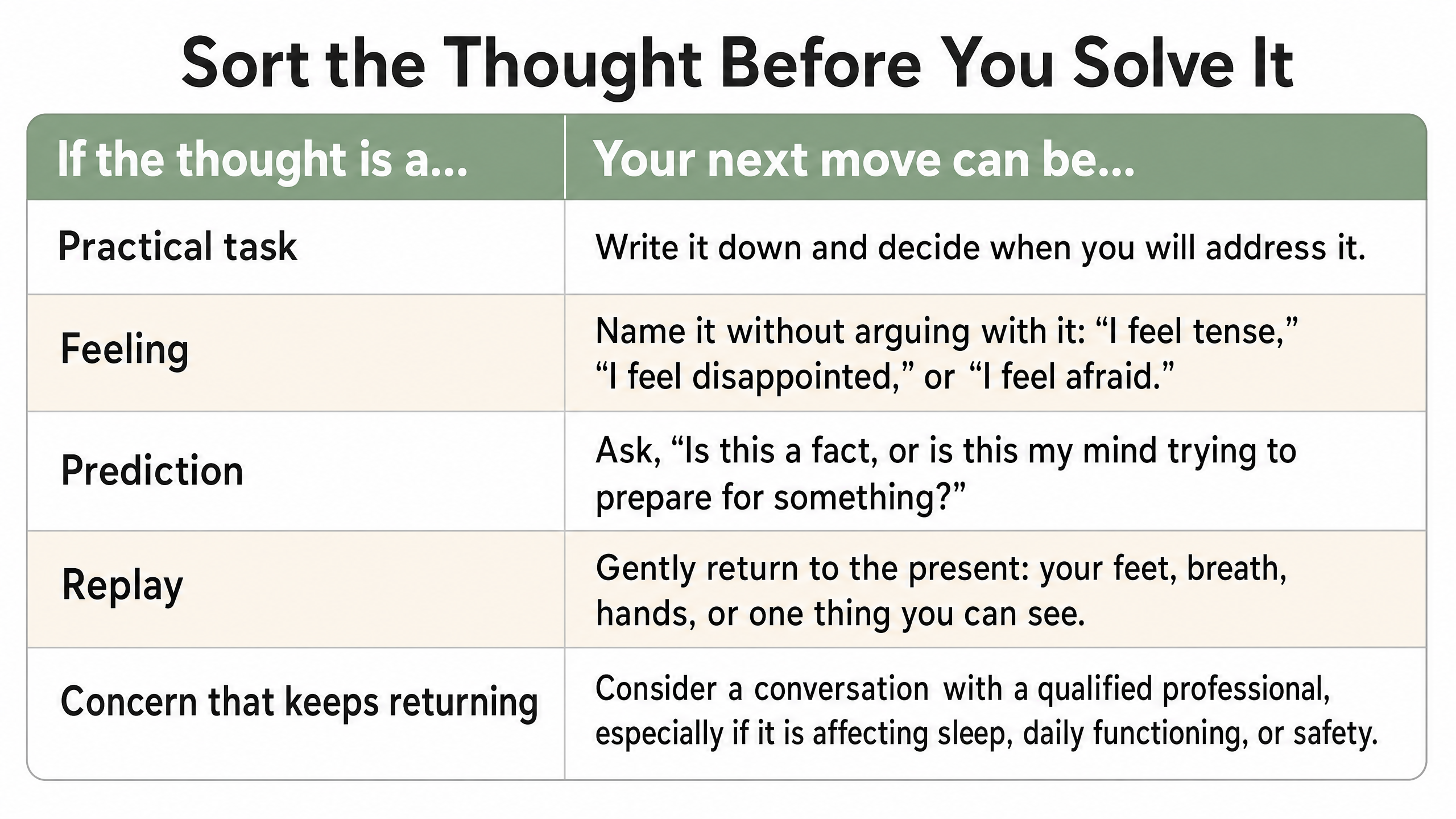
This is not about becoming detached from real responsibilities. It is about refusing to treat every mental alert as an emergency.
A three-minute practice for a busy mind
If you have tried sitting in silence and felt more agitated, begin with structure. Structure gives the brain a simple job.
Use this practice when you get in the car, before bed, after a difficult conversation, or before you open your phone in the morning.
Minute one: arrive in your body
Put both feet on the floor or feel the support under you. Let your shoulders drop a little. Take one slow exhale.
Then name three things you can see, two things you can feel, and one sound you can hear.
You are not trying to become perfectly calm. You are giving attention a place to land.
Minute two: name what is here
Use this sentence: “Right now, I notice ______.”
You might fill it in with “a tight jaw,” “a fast mind,” “grief,” “anger,” “pressure,” or “the urge to fix everything.”
Naming is not the same as giving in. It is honest data. You cannot guide what you refuse to notice.
If a thought keeps coming, try this: “There is the thought that ______.”
That small change creates distance. It reminds you that you are the person noticing the thought, not the thought itself.
Minute three: choose the next faithful action
Ask one question: “What is the next right thing, not the next ten things?”
The answer may be drink water, send one email, step outside, make tomorrow’s list, apologize, rest, or ask for help.
If prayer is part of your rhythm, let it be simple. You might pray, “God, You are here. Help me release what I cannot control and do the next right thing.”
Prayer is not a way to force your brain into a certain state. It is a place to bring your whole self to God, including the racing thoughts. The attention practice supports your ability to notice what is happening. Prayer keeps your heart oriented toward the One who is present in it.
What this looks like on an ordinary Tuesday
Let’s make this real.
You have spent the day helping everyone else. At 9:30 p.m., you plan to go to bed. Instead, you remember a work message, open your laptop, and then fall into an hour of half-working and half-worrying.
Try a different sequence.
First, write the work task on a page with a time you will revisit it tomorrow. Second, do the three-minute practice. Third, ask whether there is anything you can actually do tonight that would improve the situation.
If the answer is no, your task is not more thinking. Your task is to close the loop for the night.
Or perhaps you are sitting at a child’s practice and your mind starts making a long list of everything that could go wrong in the next year. Notice that you are future-traveling. Feel your feet against the ground. Look at the practice in front of you. Say, “I am here today. Today has enough to carry.”
That is not denial. It is choosing not to spend today’s energy living in an imagined future.
What not to do when you are trying to settle
You do not need to make stillness another performance category.
Avoid these traps:
Do not grade the practice. A wandering mind does not mean you did it wrong. Returning your attention is the practice.
Do not force an intensity you cannot sustain. Three minutes done most days is more useful than thirty minutes done once and then abandoned.
Do not use quiet to avoid necessary action. If you need to make a call, set a boundary, seek care, or have a difficult conversation, stillness can help you approach it with more steadiness. It cannot do it for you.
Do not confuse spiritual avoidance with faith. Scripture, prayer, and worship are not tools for pretending pain is absent. They are places to bring your real life before God.
One small practice repeated in a real life is more powerful than an ideal routine you never use.
When a racing mind needs more than a reset
A busy mind is common. Yet you do not have to carry severe or persistent distress alone.
If racing thoughts are regularly disrupting sleep, work, relationships, appetite, or your ability to function, speak with an appropriately qualified healthcare professional. If you are experiencing thoughts of harming yourself or feel unsafe, seek immediate support through emergency services, a crisis line, or a local emergency department.
This article provides education and practical brain-health habits. It is not medical advice, diagnosis, or treatment. New, severe, or persistent symptoms should be discussed with an appropriately qualified healthcare professional.
You are allowed to stop chasing a blank mind
Stillness is not the absence of thought. It is the decision to stop handing every thought the steering wheel.
You may not be able to make your mind quiet on command. You can learn to notice when it runs ahead, return to the present, and choose one next step that fits the moment you are actually in.
This week, take three minutes before bed. Sit with both feet grounded, name what you notice, and ask God for the next right thing. Do not try to solve your whole life in those three minutes.
Knowing that your brain needs less pressure is one thing. Changing the pattern when you are tired, overloaded, and used to putting everyone else first is another. If you have tried to reset your habits on your own and nothing has lasted, you do not need another list of things you should do. You need support that helps you build a different daily rhythm. I help women retrain the stress, sleep, and thought patterns that keep them stuck in overdrive.
For a simple place to begin, download 5 Habits That Quietly Steal Your Peace.
You do not have to solve every thought to return to the life in front of you.

Brain Health Matters, LLC
Brain health for real life under pressure.


© 2026 Brain Health Matters, LLC. All rights reserved.